
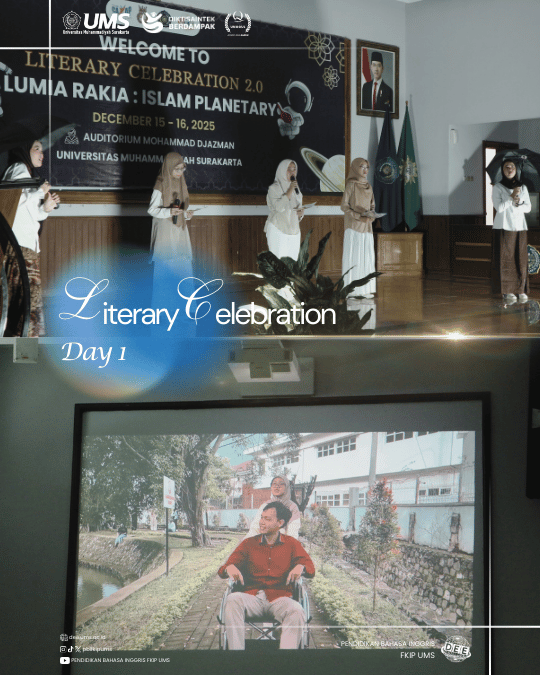
The Department of English Education (DEE), Faculty of Teacher Training and Education (FKIP), Universitas Muhammadiyah Surakarta (UMS), officially opened Literary Celebration 2.0 on December 15, 2025, at the M. Djazman Auditorium UMS. Carrying the theme “Lumia Rakia: Islamic Planetary”, the event served as an academic and artistic forum that brought together literature, Islamic spirituality, and ecological awareness through the lens of eco-theology.
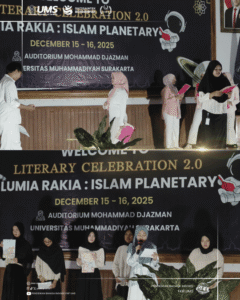
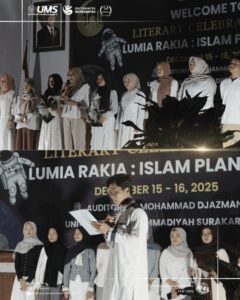
Literary Celebration 2.0 is a collaborative academic project of the Poetry and Fiction courses taught by Dr. Phil. Dewi Candraningrum, as well as the Literary Appreciation course guided by Dr. M. Thoyibi and Dr. Nurhidayat. The participants were seventh-semester students of DEE FKIP UMS, who presented poetry readings, fictional performances, and short film screenings as the culmination of their semester-long academic and creative reflection.
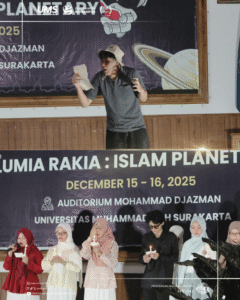
The event was officially opened by the Dean of FKIP UMS, Prof. Dr. Anam Sutopo. Day 1 also featured Rehan Zayer Sabir, a Pakistani poet and writer, as the main jury for the literary performances. In his address, he emphasized that integrating Islamic values and environmental awareness through literature is highly relevant to today’s global challenges. He highlighted that environmental crises are not merely ecological problems, but also moral and spiritual ones, and that literature offers a reflective medium to address these concerns.
The theme “Lumia Rakia: Islamic Planetary” was introduced as the conceptual foundation of the event. Lumia Rakia symbolizes the guardian of light, representing moral responsibility, ethical awareness, and human accountability. Meanwhile, Islamic Planetary reflects an Islamic worldview that positions humans as stewards (khalifah) of the Earth, entrusted with maintaining balance rather than exploiting nature. This framework anchored all literary works presented during the celebration.
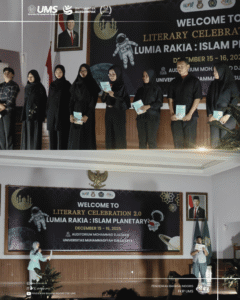
Through Day 1 activities, students were encouraged to reinterpret literary texts and environmental realities through Islamic ethics, the principle of rahmatan lil ‘alamin, and planetary sustainability. Literature was thus positioned not only as an aesthetic expression, but also as a medium for ethical reflection and cultural da’wah.